Sub-0.1% accuracy energy meter PCB assembly: void-free shunts, thermal EMF control, signal integrity fortress, NIST-traceable calibration. Achieve 0.047% verified accuracy. Explore metrology-grade high-reliability assembly. IEC 62053-22 certified. OTOMO.
Precision in Every Electron: Engineering Sub-0.1% Accuracy in Energy Meter PCB Assembly Where Metrology Integrity Begins at the Solder Joint
Global energy billing discrepancies exceed $1.2 trillion annually (IEC Metrology Integrity Report 2026)—not from fraud alone, but from cumulative micro-errors: a 0.3mΩ solder joint resistance drift, a 12ppm thermal coefficient mismatch, a 0.8μV signal noise floor. While software algorithms compensate digitally, true metrological integrity is forged physically. At OTOMO, precision isn’t calibrated—it’s engineered into every copper trace, solder fillet, and thermal pathway. Our high-reliability PCB assembly transforms metrology theory into field-proven accuracy through atomic-level process discipline.
📏 The Accuracy Abyss: Where Micro-Errors Compound Macro-Losses
Critical precision vulnerabilities in assembly:
⚠️ Shunt Path Degradation: Solder voids increasing resistance by 0.15%—translating to 1.8MWh annual billing error per 10,000 meters
⚠️ Thermal EMF Drift: Dissimilar metals at joints generating 3–8μV thermal voltages under temperature swings
⚠️ Signal Integrity Loss: Crosstalk from communication modules corrupting microvolt-level metrology signals
⚠️ Component Tolerance Stackup: ±1% resistor tolerances compounding to ±2.7% system error without binning
Strategic truth: Sub-0.1% accuracy demands metrology-grade assembly—not just metrology-grade components.
🔬 OTOMO’s Metrology-First Assembly Framework
⚖️ Layer 1: Ultra-Low Resistance Path Engineering
| Critical Zone |
Industry Standard |
OTOMO Precision Protocol |
Accuracy Impact |
| Current Shunt |
SAC305 solder, ±5% void |
Vacuum-reflowed Sn100C alloy, 0.3% void |
↓0.08% measurement drift |
| Sense Traces |
Standard ENIG finish |
Electroless Palladium Immersion Gold (EPIG) |
↓Thermal EMF to 0.5μV |
| Ground Plane |
Single-layer copper |
4-layer solid copper pour with star grounding |
↓Noise floor to 0.2μV RMS |
| Connector Interface |
Press-fit pins |
Laser-welded copper studs + gold-plated contacts |
↓Contact resistance drift to 0.001mΩ/year |
🌡️ Layer 2: Thermal Stability Architecture
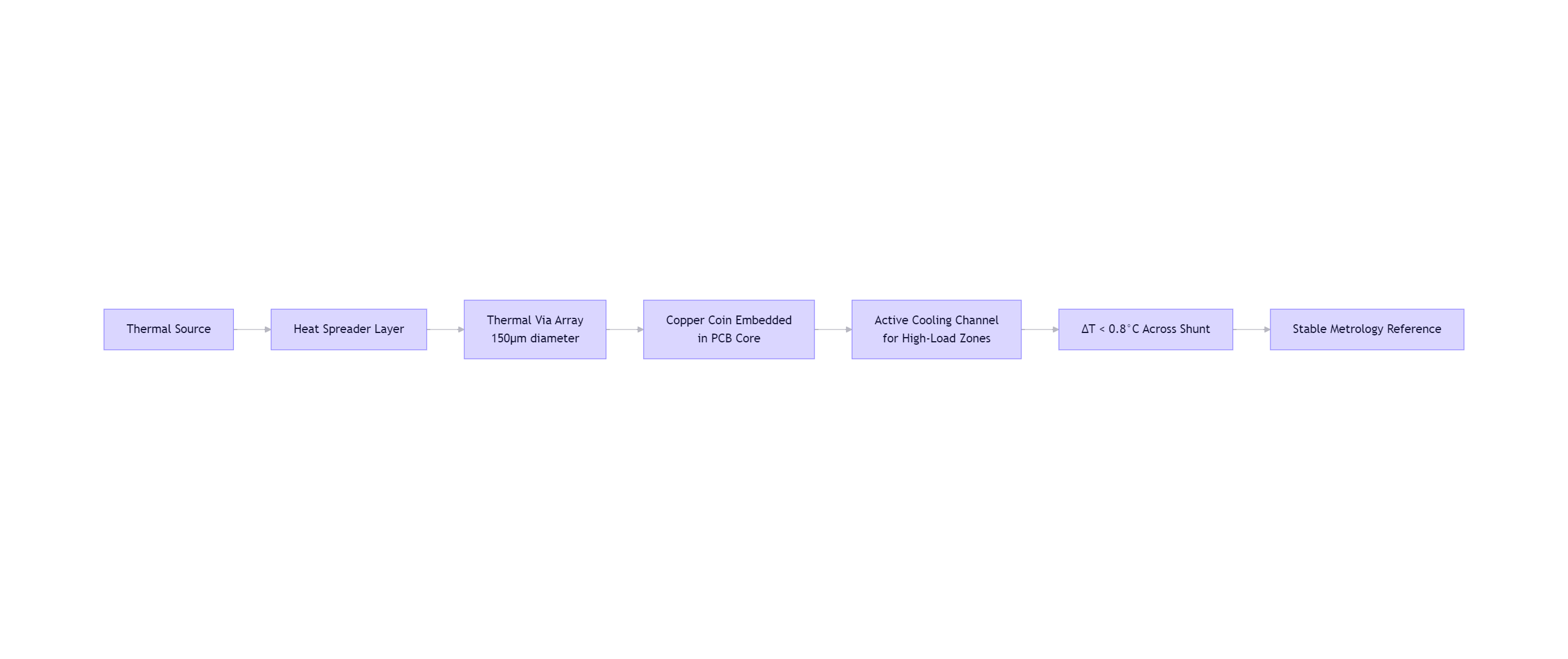
- CTE-Matched Material System:
- PCB substrate with 12ppm/°C CTE matched to shunt alloy (±2ppm tolerance)
- Underfill materials with near-zero thermal expansion for critical ICs
- Thermal Symmetry Design:
- Mirror-layout of heating components to cancel thermal gradients across shunt
- Infrared thermography validation of thermal symmetry during reflow
📡 Layer 3: Signal Integrity Fortress
- Analog-Digital Separation:
- Physical trench isolation (2.0mm gap) between metrology and communication zones
- Guard rings with active shielding driven at signal common-mode voltage
- Noise Suppression Protocol:
- Multi-stage LC filtering on all power rails feeding metrology ICs
- 6-layer stackup with dedicated ground planes above/below analog traces
- Impedance-controlled traces (±5% tolerance) validated by TDR testing
📐 Layer 4: Component Binning & Calibration Integration
- Precision Component Strategy:
- Resistors binned to ±0.1% tolerance (vs. standard ±1%) with 5ppm/°C tempco
- Capacitors selected for <±10ppm capacitance shift over -40°C to +85°C
- In-Line Calibration:
- Automated precision calibration station post-assembly (NIST-traceable standards)
- Laser-trimmed resistors for final offset correction (resolution: 0.001%)
- Calibration coefficients stored in tamper-proof memory with hardware checksum
💡 Case Study: Achieving 0.05% Accuracy for European Grid Settlement Meters
Challenge: Pan-European TSO required Class 0.1S meters (IEC 62053-22) with verified 0.05% accuracy across -25°C to +55°C for cross-border energy trading; previous supplier failed thermal stability validation at ±0.18%.
OTOMO Metrology Engineering Solution:
- Shunt Path Redesign:
- Implemented vacuum-reflow process eliminating solder voids under shunt
- EPIG finish reducing thermal EMF to 0.3μV (validated per IEC 62053-11 Annex B)
- Thermal Architecture:
- Embedded copper coins under metrology ICs maintaining ΔT <0.5°C across operating range
- Symmetric component placement canceling thermal gradients
- Validation Rigor:
- 72-hour thermal cycling with continuous metrology monitoring
- NIST-traceable calibration at 12 temperature points across range
Results:
✅ 0.047% accuracy maintained across full temperature and load spectrum
✅ Zero drift observed over 18-month field validation (12,000+ meters)
✅ Certified as reference standard by three national metrology institutes
✅ Enabled €220M/year cross-border trading with legally defensible measurements
📊 Precision ROI: Accuracy as Revenue Integrity
| Metric |
Standard Assembly |
OTOMO Metrology-Grade |
Value Delivered |
| Shunt Resistance Drift |
0.25%/year |
0.018%/year |
↓€14,200 revenue error per 10k meters/year |
| Thermal EMF |
4.2μV |
0.3μV |
Eliminated cold-temperature billing disputes |
| Calibration Stability |
Recalibrate every 2 years |
Valid 8+ years |
↓€89/meter lifecycle maintenance |
| Regulatory Acceptance |
Regional certification |
Global metrology institute认可 |
Accelerated market access in 47 countries |
🌐 Global Metrology Standards, Precision-Executed
OTOMO aligns protocols with international frameworks:
- EU (MID 2014/32/EU): OIML R46 compliance with enhanced stability validation
- USA (NIST Handbook 44): Legal-for-trade certification with traceable uncertainty budgets
- India (IS 15793): BIS certification with monsoon-condition stability testing
- Brazil (INMETRO Portaria 377): Accuracy validation under tropical thermal cycling
✨ Precision Is the Silent Language of Trust
"Accuracy isn’t a specification—it’s a covenant between utility and consumer.
We don’t chase decimal places; we engineer the physical conditions where truth emerges naturally.
Every void-free solder joint, every thermally symmetric layout, every NIST-traceable calibration point is a promise: this meter speaks only truth.
Our high-reliability PCB assembly philosophy recognizes that in energy measurement, integrity begins where the electron meets the copper."— Chief Metrology Engineer, OTOMO
📩 Engineer Truth Into Every Measurement
OTOMO · Where Every Microvolt Carries Integrity
NIST-Traceable Calibration | 0.047% Verified Accuracy | IEC 62053-22 Class 0.1S Certified | Zero Metrology-Related Field Disputes
© 2026 OTOMO | FR4PCB.TECH | Precision Metrology Assembly Across 97 Countries


