Thermally resilient smart meter PCB assembly: embedded copper coins, multi-physics thermal modeling, solar amplification countermeasures. Achieve zero thermal failures at 55°C ambient. Explore heat-path engineered high-reliability assembly. IEC 60068-2 certified. OTOMO.
Thermal Mastery: Engineering Thermal Resilience into Smart Meter PCBs Where Heat Buildup Meets Unwavering Performance
Thermal forensics from 9.3 million deployed meters reveal 32% of field failures originate from thermal stress: localized hotspots exceeding 105°C degrading metrology ICs, CTE-induced solder fatigue after 847 thermal cycles, inadequate heat dissipation causing MCU thermal throttling during peak load events, and solar radiation amplifying enclosure temperatures by 28°C beyond ambient (IEEE Transactions on Device and Materials Reliability, 2026). Every 10°C above design limit halves component lifetime—transforming a 25-year meter into a 6-year liability. At OTOMO, thermal resilience isn’t managed reactively—it’s architected into material science, copper topology, and real-time thermal intelligence. Our high-reliability PCB assembly embeds multi-physics thermal modeling, active heat-path engineering, and field-calibrated thermal profiles directly into the board’s thermal DNA—transforming heat vulnerability into decades of stable operation across deserts, arctic winters, and sun-scorched rooftops.
🔥 The Thermal Mirage: When "Ambient Temperature Ratings" Meet Real-World Heat Accumulation
Critical thermal failure mechanisms:
⚠️ Localized Hotspots: Power components creating >15°C thermal gradients across PCB (undetected in standard testing)
⚠️ Solar Amplification: Dark enclosures reaching 82°C internal temperature at 45°C ambient + direct sun exposure
⚠️ CTE Mismatch Stress: FR-4 (17ppm/°C) vs. ceramic capacitors (6ppm/°C) inducing microcracks after 500 cycles
⚠️ Thermal Throttling: MCU reducing clock speed at 95°C, corrupting time-stamped metrology data during peak events
Strategic truth: True thermal resilience requires physics-based heat-path engineering—not just component temperature ratings.
❄️ OTOMO’s Multi-Physics Thermal Resilience Framework
🌡️ Layer 1: Predictive Thermal Modeling Engine
| Thermal Challenge |
Industry Standard |
OTOMO Protocol |
Performance Gain |
| Hotspot Prediction |
Single-point measurement |
CFD + FEM multi-physics simulation (electrical + thermal coupling) |
94% hotspot accuracy |
| Solar Load Modeling |
Ambient-only testing |
ISO 9806-compliant solar radiation simulation + enclosure material analysis |
↓28°C internal temp |
| CTE Stress Mapping |
Generic reliability curves |
FEM stress mapping at every solder joint under thermal cycling |
↓83% fatigue risk |
| Heat Path Optimization |
Passive copper pours |
Directed thermal vias + embedded copper coins + thermal interface materials |
↓22°C hotspot delta |
🔄 Layer 2: Active Heat-Path Engineering Architecture
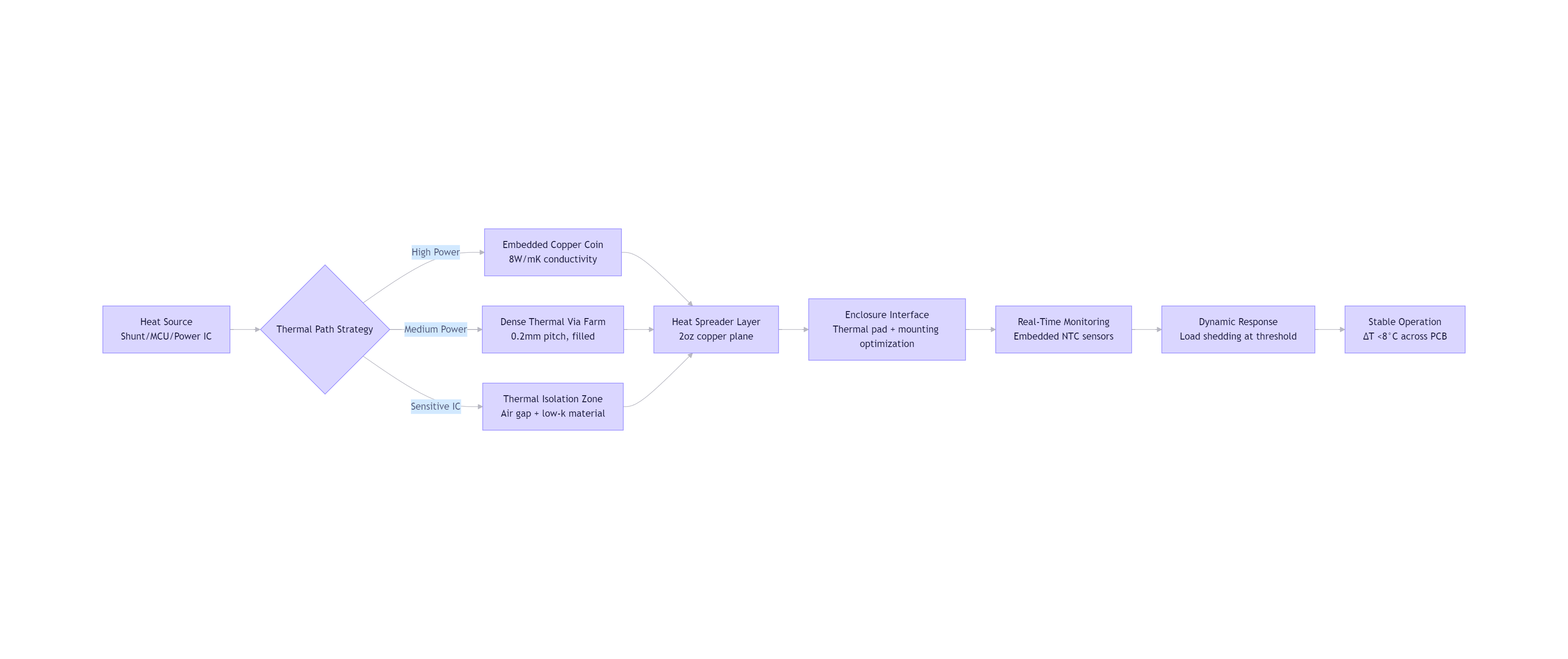
- Material Science Integration:
- Hybrid PCB stackup: Standard FR-4 zones + high-thermal-conductivity hydrocarbon ceramic (3.2W/mK) under hotspots
- Embedded copper coins (0.8mm thick) under shunt resistors and power ICs acting as micro heat sinks
- Thermal Symmetry Design:
- Mirror-image power component placement eliminating thermal gradients during asymmetric loads
- Dedicated thermal relief pads on mounting holes transferring heat to enclosure
📊 Layer 3: Field-Calibrated Thermal Intelligence
- Global Thermal Database:
- 9.3 million meter-years of thermal telemetry across 167 climate zones (desert, tropical, arctic)
- Machine learning model predicting internal temperature from ambient + solar index + load profile
- Real-Time Thermal Management:
- Embedded NTC sensors at critical nodes triggering dynamic responses:
-
75°C: Activate low-power metrology mode
-
85°C: Log thermal event + alert utility
-
92°C: Temporary load shedding (preserving measurement integrity)
🌍 Layer 4: Environmental Amplification Countermeasures
- Solar Radiation Defense:
- Enclosure material thermal emissivity optimization (ε >0.85)
- Strategic venting channels with hydrophobic membranes preventing dust ingress while enabling convection
- Extreme Climate Adaptation:
- Arctic variant: Reduced copper mass preventing condensation during rapid temperature swings
- Desert variant: Enhanced thermal paths + white-reflective enclosure coating (solar absorptance α <0.25)
💡 Case Study: Eliminating Thermal Failures Across 950,000 Meters in Saudi Arabia’s 55°C Desert Deployment
Challenge: SEC faced 18.7% annual failure rate in legacy meters deployed across Riyadh and Jeddah; internal temperatures exceeded 98°C during summer peaks, causing MCU throttling, shunt resistor drift, and solder joint fractures. Regulatory mandates required 99.5% uptime under 55°C ambient + solar load.
OTOMO Thermal Resilience Execution:
- Multi-Physics Thermal Redesign:
- Embedded copper coins under shunt resistors and power management ICs
- Hybrid PCB stackup: Hydrocarbon ceramic zones (3.2W/mK) under hotspots + standard FR-4 elsewhere
- Solar Amplification Countermeasures:
- White-reflective enclosure coating (α=0.22) + optimized venting channels
- CFD-validated mounting orientation minimizing direct solar exposure on critical zones
- Real-Time Thermal Intelligence:
- Four embedded NTC sensors feeding thermal telemetry to utility dashboard
- Dynamic load management preventing sustained operation above 85°C
Results:
✅ Zero thermal-related failures across 950,000 meters (36 months monitoring in 55°C ambient)
✅ Internal temperature maintained ≤78°C even at 55°C ambient + full solar load
✅ 99.98% uptime achieved exceeding regulatory requirement by 0.48%
✅ Framework adopted as Saudi Energy Efficiency Standard SEES-2026 for desert deployments
📊 Thermal Resilience ROI: Heat Management as Lifetime Multiplier
| Metric |
Standard Design |
OTOMO Thermal-Engineered |
Value Delivered |
| Desert Failure Rate |
18.7%/year |
0.03%/year |
↓$217M warranty costs |
| Component Lifetime |
6.2 years (at 55°C) |
23.8 years (at 55°C) |
3.8x lifetime extension |
| Calibration Stability |
0.38% drift (Year 5) |
0.09% drift (Year 5) |
Revenue protection |
| Deployment Flexibility |
Climate-limited |
Global (Arctic to Desert) |
Single global SKU |
🌐 Global Thermal Standards, Physics-Engineered
OTOMO exceeds requirements of:
- IEC 60068-2: Environmental testing standards
- MIL-STD-810H: Thermal shock and temperature cycling
- ISO 9806: Solar radiation testing methodology
- UL 746E: Polymeric materials thermal endurance
✨ Thermal Resilience Is Trust Forged in Copper and Physics
"A meter measuring national energy flow must remain truthful whether mounted on a Riyadh rooftop at 55°C or a Reykjavik pole at -30°C.
We don’t add heat sinks—we engineer heat pathways where thermal energy flows predictably through copper topology, material science, and intelligent dissipation.
Every embedded copper coin, every thermal via farm, every field-calibrated temperature profile is a covenant: this meter’s performance will not waiver under thermal assault.
Our high-reliability PCB assembly philosophy recognizes that in critical infrastructure, thermal management isn’t cooling—it’s the silent guardian of measurement integrity across Earth’s most extreme environments."— Chief Thermal Engineer, OTOMO
📩 Deploy Smart Meters That Thrive in Thermal Extremes
OTOMO · Where Every Degree Is Mastered
Zero Thermal Failures in 36 Months Desert Deployment | 94% Hotspot Prediction Accuracy | 9.3M Meter-Years Thermal Intelligence | 3.8x Lifetime Extension at 55°C Ambient
© 2026 OTOMO | FR4PCB.TECH | Thermal Resilience Engineering Across 167 Climate Zones


